
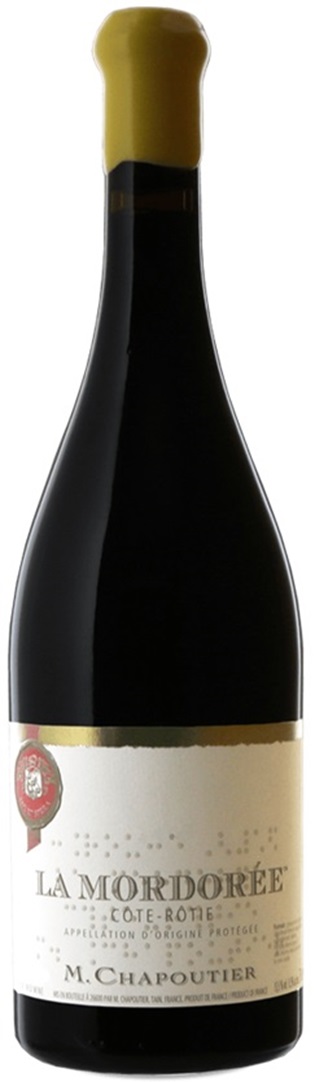
M. Chapoutier, Cote Rotie, La Mordoree 2010
Standard - 75cl
Stock location: United Kingdom
In Stock
- Vintage2010
- ColourRed
- ProducerM. Chapoutier
- CountryFrance
- RegionRhone
- Sub RegionCote Rotie
- DesignationAOP
- Bottle SizeStandard - 75cl
- ABV13
- LWIN11095992010
- Avg. Critic Score4★★★★★★★★★★
Wine Critic Reviews
There are 440 cases of the 2010 Cote Rotie La Mordoree. While it is a very strong effort, I would rank it a point or two below the 2009, which I believe is the finest La Mordoree since the awesome 1991. It offers an impressive dense ruby/purple color along with a sweet bouquet of bacon fat, black olives, black currants, raspberries, earth and forest floor. Ripe and medium-bodied with light to moderate tannin, it is somewhat closed at present, and will benefit from 4-5 years of cellaring. It should keep for 20-25 years. In November of this year, Michel Chapoutier finally made the cover of The Wine Spectator. The accompanying article said essentially the same things I had written about over twenty years ago. More importantly, I am thrilled that Chapoutier received this attention because it has long been deserved. History will record that Michel Chapoutier is a revolutionary. He is also a highly emotional man whose infectious love of primitive art, historic books, classical music and, of course, terroir and winemaking are seemingly impossible to harness. Michel Chapoutier was among the first in France to embrace the radical biodynamic agricultural teachings, for which he was initially criticized, but is now praised. He was also the first to print all his labels in Braille, something that cynics considered to be a gimmick, but ask the National Association for the Blind what they think. Coming from a famous family, but moving in a direction unlike any of its previous members, Michel Chapoutier is self-taught. What he has accomplished over the last two decades or more is one of the great wine stories of the modern era. With all his outgoing, boisterous, machine-gun-speed prose that can sometimes sound shockingly cocky, and at other times reminiscent of the famous Lebanese poet Khalil Gibran, there is never a dull moment around Chapoutier., who makes comments such as “Filtering wine is like making love with a condom,” and “Acidifying wine is like putting a suit of armor on the vineyard’s terroir, vintage character and the cepage.” Don’t blame him if his brilliant intellect and shocking vocabulary put his visitors on the defensive. Michel Chapoutier has proven through his genius, the faith of his convictions and backbreaking attention to detail in his vineyards and in the winery that a once moribund negociant (yet with significant vineyard holdings) could become a beacon of inspiration and quality for the entire world. In short, every wine consumer in the world should admire his accomplishments. All of Chapoutier’s lower level 2010 whites and basic reds have long been sold out, so to keep the tasting somewhat limited during my visit, we focused on the more recently released 2010 white and red selections parcellaires and nearly all the 2011s. As for the 2010 selection parcellaire whites, they are spectacular. Le Pavillon, once called Rochefine and owned by Jaboulet-Verchere, consists of 10 acres of pure granite in the famed Les Bessards, which is considered by many to be the single greatest terroir of Hermitage. The Ermitage Le Pavillon, which is meant to age for 50+ years, is Michel Chapoutier’s legacy, and he is confident that history will support his belief in this extraordinary wine. Michel Chapoutier is not alone in believing the 2011s may resemble a more modern day version of 1991. That vintage was largely underrated by just about everybody (except yours truly) because all the accolades and hyperbole were largely bestowed on both 1989 and 1990 (deservedly), but in the Northern Rhone 1991 turned out to be a strikingly superb vintage for Cote Rotie, Hermitage, Cornas and Condrieu. In the Southern Rhone, the vintage was largely a disaster. Following is an overview of what to expect with the inexpensive 2011 whites and reds. Most of these wines do not have the weight, power or tannic structure of the 2010s, but they are by no means diluted or wimpish wines. They tend to be charming, fruit-forward and seductive, and thus may be preferred by consumers looking for immediate gratification. Although the first few wines reviewed are Southern Rhones, they need to be covered because they are in bottle, and I did not review them in issue 203. Along with several other producers, Michel Chapoutier has helped increase the world’s attention to the long-forgotten, microscopic appellation of St.-Peray. Chapoutier produces a bevy of St.-Perays under his own name as well as in partnership with two three-star chefs, Sophie Pic, of the Restaurant Pic in Valence (as well as several culinary branches in Paris and Lausanne, Switzerland), and Yannick Alleno, the brilliant chef at the Hotel Le Meurice’s in Paris. The red 2011 selections parcellaires are already fruit-forward and seductive. Readers should love them as they are much more evolved than the more structured, powerful, dense, tannic 2010s. Importer: Terlato Wines International, Lake Bluff, IL; tel. (847) 604-8900
- Drinking Window: 2016 - 2041
- Reviewer Name: Robert Parker
- Review Date: December 2012
(100% syrah, from vines in the Cote Blonde that are reportedly almost 65 years old): Opaque ruby. An exotically perfumed bouquet presents candied dark berries and cherry-cola, with notes of Indian spices, anise and smoked meat building with air. Fleshy but focused on the palate, with intense black and blue fruit flavors and a touch of candied violet. Tangy minerals add lift and cut to a strikingly long, smoky and gently tannic finish.
- Reviewer Name: Josh Raynolds
- Review Date: March 2013